
Zambia’s Pro-Business President Wins Second Term in Election
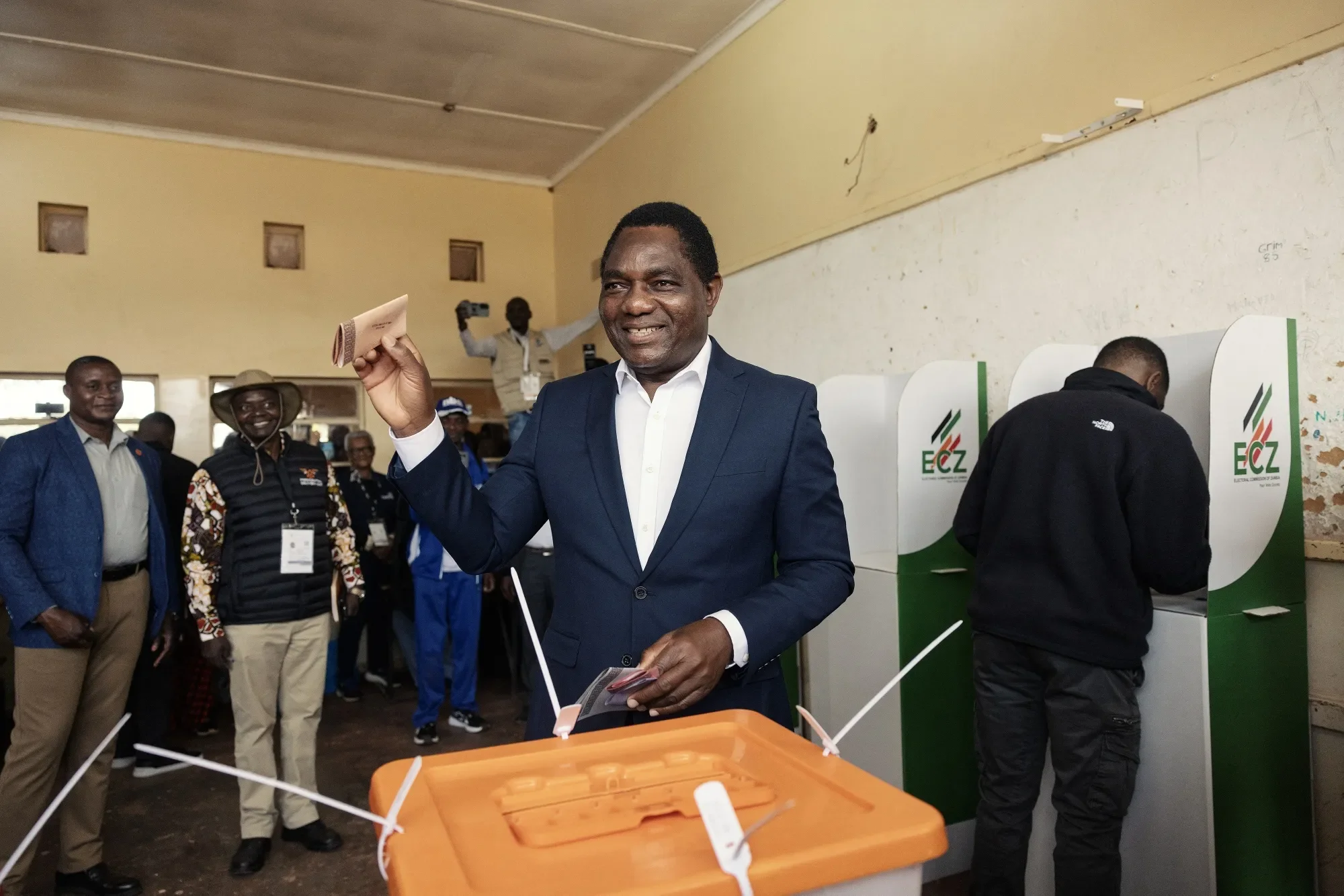
Hakainde Hichilema was declared the winner of Zambia’s elections, an outcome that investors will welcome as he sets out to build on economic successes in Africa’s second-biggest copper producer.
Hichilema, 64, secured a second five-year term with 2.97 million votes from the Aug. 13 ballot, while his main challenger, Brian Mundubile, got 1.86 million, the electoral commission declared early on Tuesday. Based on the reported tally, Hichilema won 60.5% of the votes cast versus 38% for his rival.
“We must work harder than ever before to deliver meaningful development for every single Zambian,” Hichilema said in a statement shortly after the result was declared. “To those citizens who preferred the ideas presented by our opponents, we hear you, and we will continue to work for you.”
The removal of uncertainty over the election outcome may boost Zambia’s kwacha — Africa’s best-performing currency this year — and reduce government borrowing costs on longer-term kwacha bonds, according to Mutisunge Zulu, a Lusaka-based economist.
“There is foreign money that has been sitting out the kwacha curve on political risk rather than on any credit view,” he said. “The removal of that uncertainty brings it in.”
The kwacha traded 0.8% firmer at 18.78 per dollar by 9:24 a.m. in Lusaka.
Hichilema’s victory presents an opportunity to focus on boosting Zambia’s economic expansion, having done what he called the “heavy lifting” of restoring stability after a painful years-long debt-restructuring process.
Leading the United Party for National Development, Hichilema aims to secure a new program with the International Monetary Fund by year-end.
“Investors will be happy with the continuity of another HH term,” said Connor Vasey, frontier markets director at Eurasia Group, referring to Hichilema’s nickname. “His camp frames the second term as one which will accelerate positive change, so expectations are high.”
The election win was bigger than the landslide 59% he garnered in 2021, while the 57.2% voter turnout was far below the more-than 70% recorded five years ago.
‘Democracy Constraints’
Mundubile’s campaign tapped into broad dissatisfaction among Zambia’s majority-poor population with rising living costs and incomes that have failed to keep up. His rallies drew large crowds, and the 55-year-old lawyer and accountant said the electoral process was neither free nor fair.
The European Union Election Observation Mission’s preliminary report, released Saturday, found that the ballot took place against a backdrop of “a constrained democratic space.”
The group cited restrictions on the ability to campaign, and incumbency advantages that blurred the line between state and political electioneering, creating an uneven playing field. Public media was heavily skewed in favor of the ruling party, according to the EU EOM, an issue that other observer missions also flagged.
The electoral commission’s surprise Friday announcement that it suspended vote counting and results announcements, citing incidents of violence it didn’t specify, also drew criticism. It resumed counting a few hours later after declaring the situation to be contained.
Mundubile said the military raided his Lusaka home on Thursday night, shooting two members of his team. The government later said the police “led a joint operation to apprehend suspected militia” at the premises, and arrested 11 people after exchanging fire.
The police and military personnel have maintained a heavy presence across Lusaka, the capital.
Hichilema will start his next term with significant tailwinds from near-record prices for copper, which accounts for more than 70% of Zambia’s export earnings. He plans to triple output by 2031 to 3 million tons annually — worth more than $40 billion at today’s prices.
On the other hand, the risks of a severe El Niño weather event threatens to bring drought across much of Zambia in the coming months. That could decimate harvests next year, forcing up food prices and choking hydropower that the nation relies on for most of its electricity production.
Still, a record corn crop this year creates a buffer, former Finance Minister Situmbeko Musokotwane said in an interview this month. Zambia also added solar generation capacity and is expanding coal-fired power, which will help cushion the impact of any weather shock, he said.
Read the full piece on Bloomberg here.