
Zambia Investor Briefing - February 2026
SIGN UP HERE TO RECEIVE NEXT MONTH’S BRIEFING DIRECT TO YOUR INBOX
February 2026
In this month's briefing: Inflation fell to 7.5% in February - within the central bank's 6-8% target band for the first time in nearly seven years - prompting a 75 basis point rate cut to 13.5%. World Bank support surpassed $3 billion as GDP growth projections strengthened to 6.4% for 2026. Major infrastructure approvals included Tanzania-Zambia and Namibia-Zambia petroleum pipelines, while China's zero-tariff policy effective 1 May opens new export opportunities across agriculture and manufacturing sectors.
🔢 FEBRUARY IN NUMBERS
→ 7.5% - February inflation (first time in target band since 2019)
→ 13.5% - Policy rate (75bps cut, largest since 2020)
→ $3B+ - World Bank support portfolio
→ $12B - Mining sector investments secured (2021-2025)
→ $72M - Ghana-Zambia fintech deals ($7M concluded, $65M negotiating)
→ 8,000 - Jobs from Ghana partnership deals
→ $130M - ERB-approved energy licences (K2.45B)
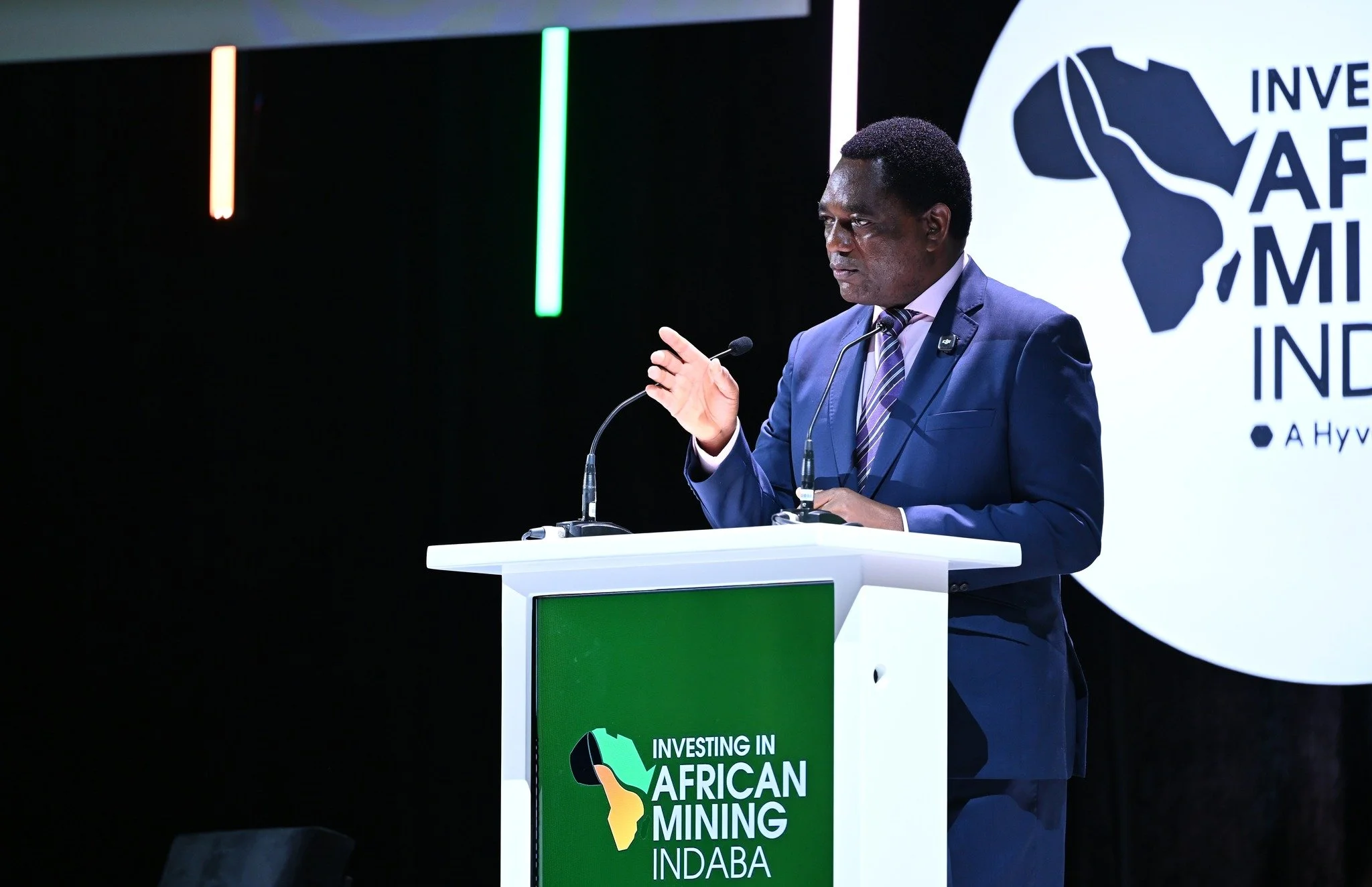
President Hichilema delivers the keynote address at Mining Indaba 2026 in Cape Town.
📝 POLICY AND GOVERNANCE DEVELOPMENTS
Inflation Hits Target Band
Annual inflation fell to 7.5% in February from 9.4% in January, reaching the Bank of Zambia's 6-8% target band for the first time since May 2019, faster than the central bank's second-quarter projection. Food inflation cooled to 8.2% from 10.9% while non-food prices softened to 6.5% from 7.3%. The Kwacha rallied 17% year-to-date. The achievement strengthens the case for further rate cuts at May's Monetary Policy Committee meeting.
Central Bank Rate Cut
The Bank of Zambia lowered its key interest rate to 13.5% from 14.25%, implementing a 75 basis point cut—the largest since 2020. Governor Denny Kalyalya projected inflation will average 6.9% in 2026 (revised from 7.6%) and reach 6.3% in 2027. Foreign exchange reserves increased to $5.5 billion (4.8 months import cover). Risks remain tilted to the downside, with favourable weather, high metals prices and macroeconomic stability alleviating pricing pressures.
IMF Talks Timeline
Finance Minister Situmbeko Musokotwane confirmed IMF negotiations will begin "almost immediately" but finalise only after the August elections. With macroeconomic stability achieved, the next programme will focus on growth and job creation. Musokotwane reaffirmed fiscal consolidation commitment regardless of programme status. Copper price surges boost revenues while constitutional amendments increase parliamentary constituencies requiring supplementary budget allocations.
World Bank Support Surpasses $3 Billion
The World Bank confirmed financial support to Zambia surpassed $3 billion, with the portfolio expected to grow further. World Bank Vice President Guangzhe Chen noted the expanding program reflects confidence in Zambia's reform trajectory and economic governance. The delegation launched the Knowledge Impact Programme—a new agriculture initiative providing direct support to smallholder farmers to strengthen productivity and resilience.
Economic Reforms Delivering Results
Finance Minister Musokotwane stated economic reforms are delivering results with macroeconomic stability established. Pension withdrawals totalling K10.6 billion reached 518,000 contributors, water access expanded to 4.9 million citizens, 60,000 new electricity connections were made. GDP growth is projected at 6.4% in 2026 with fiscal deficit falling to 2.1% (from 9% in 2021). Manufacturing commitments exceed $4 billion with investment pledges from 20 companies generating 31,000 jobs.
⚡️ ENERGY & INFRASTRUCTURE
Tanzania-Zambia Pipeline Approved
Zambia’s Cabinet approved construction of the Tanzania-Zambia Multi-Products Pipeline through public-private partnership, positioning Zambia as an emerging regional energy hub. The pipeline will complement existing TAZAMA infrastructure to meet fuel demand projected at 3.7 million tonnes annually by 2030. Cabinet also approved the Namibia-Zambia Refined Petroleum and Natural Gas Pipeline, creating multiple supply corridors to safeguard against disruption and price volatility.
Kazungula Bridge Authority Launched
President Hichilema called on African nations to take ownership of economic development during the launch of the Kazungula Bridge Authority in Kasane, Botswana. The bridge has become the preferred route for countries further north, with truck traffic expected to rise from 400 trucks daily to 1,000. Hichilema stressed increased traffic must translate into real economic value including trade efficiency, lower transportation costs, and business growth. Botswana President Duma Boko emphasised Africa must break free from exporting raw minerals and importing finished products, calling for value addition and industrialisation.
ERB Energy Licences
The Energy Regulation Board approved 29 licences and 5 construction permits worth K2.45 billion ($130 million). The approvals strengthen Zambia's renewable energy infrastructure and demonstrate continued private sector confidence in the energy sector. The licences support government's diversification strategy away from hydropower dependency while addressing capacity constraints.
EU Lobito Corridor Investment
The European Union committed $130 million for key road infrastructure supporting the Lobito Corridor. The investment strengthens regional connectivity linking Zambia's copper production to Atlantic port access through Angola, reducing transport costs and transit times. The corridor represents strategic infrastructure positioning Zambia within evolving regional trade networks and critical mineral supply chains.
⛏️ MINING AND INDUSTRIAL DEVELOPMENTS
Mining Indaba Keynote
President Hichilema delivered the keynote address at Mining Indaba 2026 in Cape Town, announcing mining sector reforms have attracted approximately $12 billion in investments over four years. The President highlighted recapitalisation of Konkola Copper Mines and Mopani Copper Mines as key to achieving 3 million tonne copper production by 2031. Institutional changes including the Mines Appeals Tribunal and Cadastre Department have strengthened governance. Hichilema positioned Zambia as the partner of choice for responsible mining investment.
ZCCM-IH Metals Trading Strategy
ZCCM Investments Holdings is developing plans to start trading commodities to capture more value from mineral wealth. CEO Kakenenwa Muyangwa confirmed ZCCM-IH wants to access production from portfolio companies equivalent to ownership stakes to sell internationally. ZCCM-IH is transitioning from dividends to royalties, having successfully implemented a 3.1% royalty model with First Quantum at Kansanshi. The company approached China Nonferrous and JCHX Mining about following the model.
Manufacturing Price Reductions
More than 30 manufacturers announced price cuts on essential household and industrial goods following government pressure. Reductions span mealie meal, sugar, cooking oil, soya pieces and mattresses. Breakfast mealie meal dropped from K300 to K260, Zambia Sugar cut prices by 5%, and Seba Soya Pieces saw 19% reductions. Zambia Association of Manufacturers President Mohammed Umar attributed cuts to improved macroeconomic fundamentals including strengthening Kwacha and easing inflation.
🌍 TRADE & POLICY
China Zero-Tariff Policy
China'szero-tariff treatment on imports from 53 African countries, including Zambia, takes effect May 1st, 2026. The policy lowers entry costs for qualifying exports and widens market access for local producers. Honey, soy products and tobacco are identified as potential growth areas. The administration's broader programme - including TAZARA railway rehabilitation and special economic zones expansion - reinforces ambitions for Zambia to evolve into a regional production base.
UAE Bilateral Trade
UAE-Zambia bilateral trade hit $3.4 billion with the UAE targeting deeper commercial ties. The relationship reflects growing Gulf state interest in Zambian mining assets and infrastructure projects, following International Resources Holdings' acquisition of Mopani Copper Mines in 2023.
Ghana Partnership
Ghana and Zambia forged a comprehensive economic partnership during President Mahama's state visit spanning mining sector knowledge sharing, trade facilitation, and investment promotion. A Zambia-Ghana Business Dialogue yielded fintech transactions worth $7 million concluded between companies with $65 million in negotiations underway—deals expected to generate 8,000 jobs. The partnership demonstrates South-South collaboration models between African nations pursuing economic transformation.
FEBRUARY MILESTONE ⛰️
February's inflation return to the 6-8% target band after nearly seven years validates Zambia's macroeconomic stabilisation program. The 7.5% reading, achieved faster than projected, enabled the Bank of Zambia to implement its largest rate cut since 2020—signaling a fundamental shift from crisis management to growth orientation. Combined with $5.5 billion in reserves, 6.4% GDP growth projections, and manufacturers voluntarily reducing prices, the convergence demonstrates that fiscal discipline is translating into tangible household benefits. The milestone positions Zambia to negotiate a growth-focused IMF program from strength rather than distress.
👀 WHAT WE’RE WATCHING IN MARCH
→ Bank of Zambia inflation trajectory toward 6% lower bound target
→ Tanzania-Zambia pipeline financing structure and construction timeline
→ ZCCM-IH metals trading strategy implementation and Mercuria partnership developments
→ China zero-tariff policy (May 1st) preparation and export sector readiness
→ Manufacturing price reductions transmission to retail consumer prices
📖 WHAT WE’VE BEEN READING (AND WATCHING) IN FEBRUARY
Analysing Africa newsletter: An interview with Zambia’s president - The Economist | 24 February 2026
Zambia calls for domestic debt to be part of major indices - Financial Times | 20 February 2026
What Zambia’s 75bps interest rate cut really means for the economy - Business Insider Africa | 11 February 2026
IMF Forecasts Strong 5.8% Zambia Economic Growth for 2026 - Discovery Alert | 30 January
QUOTE OF THE MONTH
"Economic reforms are delivering results, with macroeconomic stability now firmly established and household-level benefits increasingly taking shape. Zambia is entering a period where the benefits of reform will increasingly become visible across sectors and communities."
— Finance Minister Situmbeko Musokotwane, speaking after President Hichilema's address to Parliament
CONTACT US
If you would like to find out more, receive tailored briefings on specific sectors, or send news stories to be included in the next briefing get in touch via info@zambiaisback.com. To stay up to date follow us on social media: