
Zambia Investor Briefing - July 2026
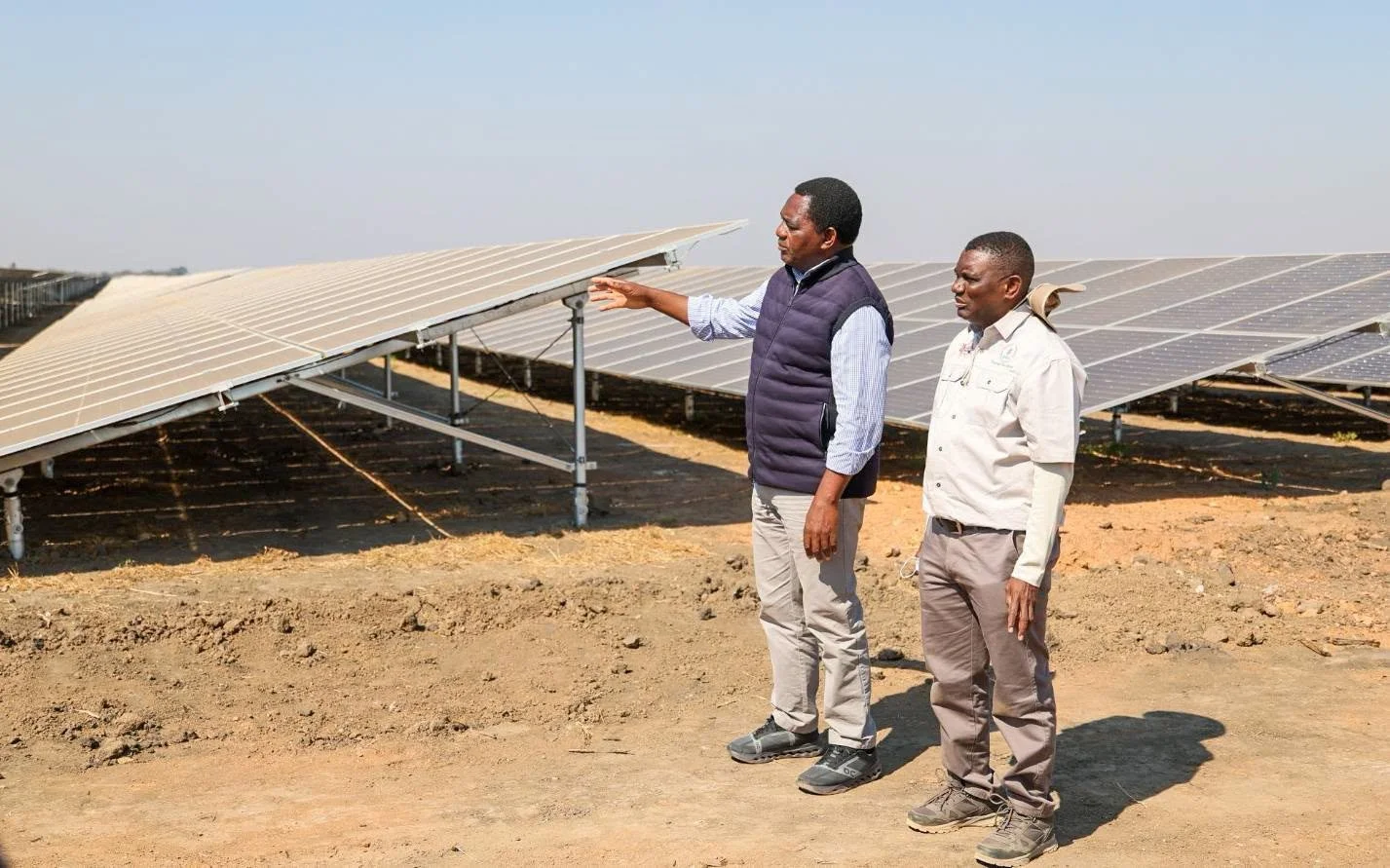
President Hakainde Hichilema inspecting the Chisamba Solar Complex on July 21, where he commissioned the 100MW Phase II plant, doubling capacity to 200MW of clean energy.
In this month's briefing:
Zambia opened its 2026 crop marketing season. The Government commissioned the 100MW Chisamba Phase II solar plant. Local-currency bonds delivered a world-beating 36% return, the kwacha held near multi-year highs, and the former Finance Minister said a new IMF programme could be agreed by year-end. Inflation held at 6.5%, the Lobito Corridor railway reached a US$753m financial close, the ZDA reported US$19bn of investment realised since 2021, and the Government's PPP pipeline swelled to US$14.2bn. Reforms targeted 40% local participation in mining, Zambia joined the new World AI Cooperation Organization, and fuel import debt fell by nearly US$700m as the country completed its largest fuel depot.
🔢 JULY IN NUMBERS
→ 36% – Local-currency bond return this year, best in emerging markets
→ 18% – Kwacha appreciation against the dollar this year
→ 6.5% – July inflation, inside the Bank of Zambia's 6-8% target band
→ US$753m – Financial close reached on the Lobito Corridor railway
→ US$19bn – Investment realised since 2021, reported by the ZDA
→ US$14.2bn – Government public-private partnership pipeline
→ US$104.9m – Tobacco sales by Week 11, from 51.96 million kg traded
→ 200MW – New capacity of Chisamba solar plant with Phase II now commissioned
→ US$700m – Fall in fuel import debt since 2022, to around US$210m
→ US$123.5m – Investment in Lusaka's new fuel depot, the country's largest
→ K347 – New FRA maize floor price per 50kg bag, up K7
→ 40% – Mining local-participation target, up from 20%
⛏️ MINING EXPANSION
President Hichilema Targets 40% Local Participation in Mining
President Hakainde Hichilema has set a target to double local participation in the mining sector from 20% to 40% through new local content reforms requiring mining companies to source goods and services from Zambian suppliers. Speaking in Chililabombwe, he tied the drive to the revival of three major Copperbelt assets, Konkola Copper Mines, Lubambe and Mingomba, and to fresh employment and business opportunities. He also pointed to a sharp rise in the Constituency Development Fund, from K1.6m to K40m per constituency, as a vehicle for community projects.
ZCCM-IH and Ministry of Mines in Talks to Set Up Gold Markets
ZCCM-IH is in talks with the Ministry of Mines to establish markets in areas where gold mining is being formalised, as part of a wider effort to formalise the country's gold and manganese sectors. Board Chairperson Phesto Musonda said the company was committed to supporting formalisation and described the move as central to the Government's broader economic agenda. He said the ministry had so far trained local miners and issued licences to between 700 and 1,000 cooperatives in areas such as Mufumbwe.
Zambia Champions Pan-African Metals ExchangePresident Hakainde Hichilema is championing a pan-African metals exchange to help African nations capture more value from their mineral wealth through greater local trading, refining and ownership. The platform would drive value addition and curb raw-material exports, building on Zambia's existing metals-trading joint venture with Mercuria Energy Group. Initial discussions have been confirmed with the Democratic Republic of Congo, with talks underway with two other nations.
⚡ENERGY AND INFRASTRUCTURE
Presidential Initiative to Build 156 Solar Plants Nationwide
Zambia has contracted a consortium of five Chinese firms to build 156 solar plants, one in every constituency, each generating 2MW for a combined 312MW. The K4.3bn (about US$160m) Presidential Constituency Energy Initiative supports the goal of lifting generation capacity from 3,500MW to 10,000MW by 2030. Construction is scheduled for completion within twelve months, coordinated by ZESCO, and is expected to create around 15,600 jobs. Local authorities will be able to hold equity stakes, giving communities a long-term revenue stream
President Hichilema Commissions Chisamba Phase II Solar PlantPresident Hichilema has commissioned the 100MW Chisamba Phase II solar plant, a US$75m investment by Kariba North Bank Extension Power Corporation, a ZESCO subsidiary, built by Power China International Group. The plant doubles the Chisamba Solar Complex to 200MW and created 1,480 jobs over a seven-month construction period. All 100MW will feed into the national grid, supporting the 10,000MW-by-2030 target, with national solar capacity now at about 800MW.
World Bank Backs 192km Zambia-Malawi Power CorridorThe World Bank has approved a US$43m International Development Association grant for the Zambia–Malawi Interconnector, a 192km cross-border transmission corridor. The funding covers about 47km of 400kV line on the Zambian side, enabling electricity trade and reducing each country's reliance on domestic generation during shortages. The link is designed to connect both nations to regional electricity markets and strengthen energy security.
FMO Prepares US$80m for Solarcentury AfricaThe Dutch development bank FMO is preparing up to US$80m in financing for Solarcentury Africa to expand solar generation across Southern Africa. The package includes US$40m to refinance existing assets, among them the 25MW Mailo solar plant in Zambia, and US$40m for future projects. Around 90% of the electricity from the immediately financed projects will supply Zambia, easing exposure to hydropower shortfalls. The merchant model allows direct sales to regional markets rather than relying solely on government power purchase agreements.
US$300m Kafue Multi-Facility Economic Zone Nears CompletionThe US$300m Golden Baobab Multi-Facility Economic Zone in Kafue is approaching completion, having broken ground in September 2025. Several companies are already installing machinery for commercial operations, positioning the zone as one of Zambia's largest industrial hubs, with capacity for manufacturing, agro-processing, energy and value-added sectors. Deputy Secretary to the Cabinet for Finance and Investment Mr Siakalenge said the development would strengthen investor confidence, expand industrial capacity and create employment.
US$14.2bn PPP Pipeline Drives Infrastructure PushAt the Zambia International Trade Fair this month, the Government showcased its private-capital drive for infrastructure, with its public-private partnership programme now overseeing about 70 projects worth more than US$14.2bn. PPP Office official Stephen Chanda said 19 concession agreements worth US$9.1bn had been signed since 2022, up from just US$35m that year, with US$780m signed in 2026 alone. The projects span transport, borders, education, housing and logistics, and have generated over 15,000 direct and 30,000 indirect jobs. Flagship schemes include the Ndola–Lusaka Dual Carriageway, nearing 80% completion, and a US$249m Mulungushi University accommodation deal.
Government Completes US$123.5m Fuel Depot
The Government has completed its largest fuel storage facility to date, a US$123.5m depot in Lusaka with capacity of 102,000 cubic metres, enough for 60 million litres of diesel, 40 million litres of petrol and 2 million litres of kerosene. Energy Permanent Secretary Prof Ephraim Munshifwa said during a tour on 24 July that the depot bolsters energy security, with strategic reserves currently at about 24 days of diesel and 17 days of petrol.
US$1.6m Project to Modernise TAZARA Railway CorridorPresident Hichilema says a US$1.6m rehabilitation of the Tanzania-Zambia Railway Authority (TAZARA) line will transform Kapiri Mposhi into one of the country's key transport and logistics hubs. The project will modernise the railway from Kapiri Mposhi to the Tanzanian port of Dar es Salaam and includes a dry port and railway workshops in the district, creating jobs and stimulating trade along the corridor. Speaking at TAZARA Main Station, the President said the dry port alone was expected to attract US$65m in investment.
💵 ECONOMY AND DEBT
Fuel Import Debt Cut by Nearly US$700m
Zambia has cut its fuel import debt from over US$900m in 2022 to about US$210m by July 2026, according to the Ministry of Energy. Permanent Secretary Ephraim Munshifwa credited the shift to private-sector-led fuel procurement, which has improved efficiency and eased the strain on public finances. The savings are being redirected towards healthcare, education and social programmes, with private companies now managing petroleum imports under greater competition.
Inflation Holds Steady at 6.5% on Kwacha Strength
Zambia's annual inflation held steady at 6.5% in July, unchanged from June and near the floor of the Bank of Zambia's 6-8% target band, as a rallying kwacha contained import costs. Statistician-General Sheila Mudenda said prices rose 0.2% on the month, with food inflation easing to 6.4% while non-food growth ticked up to 6.7%. The kwacha has appreciated almost 18% against the dollar this year, buoyed by soaring copper prices, ranking it among the world's best-performing currencies.
Zambia Targets New IMF Programme by Year-EndFormer Finance Minister Situmbeko Musokotwane says Zambia hopes to agree a new IMF programme before the end of the year, following its exit from sovereign default. The previous US$1.7bn arrangement concluded in January after underpinning the country's debt restructuring. The new programme would prioritise investment in mining, energy and agriculture to drive growth and jobs, with the Government holding off on fresh international bond issuance to reinforce investor confidence.
Local Bonds Deliver World-Beating 36% RallyZambia's local-currency government bonds have returned 36% in dollar terms this year, outpacing all other emerging-market local debt. Citigroup said a clear election win for President Hichilema would likely draw more offshore investors into upcoming auctions and push yields lower. The benchmark 10-year yield has already fallen around 70 basis points in 2026, while the kwacha has appreciated nearly 18% against the dollar, amplifying returns for international holders.
Stable Kwacha Boosts Cross-Border TradeA stable kwacha lifted cross-border trade in the first quarter, according to the Southern Africa Cross Border Traders Association. Secretary General Jacob Makambwe said currency stability had cushioned traders even amid Ebola-related restrictions in the DRC, with the kwacha holding between K17 and K19 to the dollar. The predictability has allowed merchants to forecast costs more reliably when sourcing imported goods.
🚜 AGRICULTURE
FRA Raises Maize Floor Price to K347 as Buying Begins
The Food Reserve Agency has raised its maize buying price by K7 to K347 per 50kg bag for the 2026 marketing season, with buying opening on 29 July, across 1,749 buying points nationwide. The FRA held 1.4 million tonnes of maize in stock with sufficient liquidity for this year's purchases. Zambia is expected to remain one of the few Southern African countries that will not need to import maize despite anticipated El Niño conditions, supporting food security and affordable mealie-meal prices.
EIB and EU Launch €40m Agriculture Finance Facility
The European Investment Bank and the European Union have committed €40m through three Zambian banks, Zanaco, First Capital Bank and Zambia Industrial Commercial Bank, to establish the Zambia Agriculture Value Chain Facility. The facility targets financing gaps for farmers and agri-SMEs, supporting climate-resilient practices, irrigation and modern equipment as the sector recovers from drought and power shortages. An EU-backed risk-sharing guarantee encourages lending to smaller businesses with limited collateral, alongside technical assistance.
💶 TRADE AND INVESTMENT
ZDA Announces US$19bn Investment Milestone Since 2021
The Zambia Development Agency announced that US$19bn of investment has been realised between 2021 and the second quarter of 2026, a near-20% realisation rate against US$97.07bn in total commitments. Director General Albert Halwampa said the figure demonstrated sustained investor confidence in the country's industrialisation agenda. Manufacturing and mining led the way, accounting for more than 73% of actualised investment, with transport, energy, agriculture, ICT and tourism also drawing capital.
Tobacco Sales Reach US$104.9m
Tobacco sales reached US$104.9m by Week 11 of the season, with 51.96 million kg traded, according to the Tobacco Board of Zambia. Flue-cured Virginia dominated at 44.45 million kg, averaging US$1.97/kg for US$87.34m, while air-cured Burley fetched a premium US$2.35/kg across 7.51 million kg for US$17.63m. The Board said Virginia remained the leading contributor to export earnings owing to its higher production volumes.
Lobito Corridor Railway Reaches US$753m Financial Close
The Lobito Corridor railway has reached financial close of US$753m, clearing the way for construction on one of Africa's most strategic trade routes. The financing, US$553m from the US International Development Finance Corporation and US$200m from the Development Bank of Southern Africa, will fund the rehabilitation and long-term operation of the 1,300km line from the Port of Lobito to the DRC border, with the Africa Finance Corporation acting as co-financial adviser and a Mota-Engil and Trafigura joint venture as operator. A planned new link would connect Zambia's north-west to the Angolan network, giving the Copperbelt improved access to the Atlantic.
US$49.9m Project Targets Rural Jobs and Financial Inclusion
The Government has launched the Financial Inclusion for Resilience and Innovation Project, a seven-year, US$49.9m initiative backed by the International Fund for Agricultural Development. It aims to expand access to finance, strengthen climate resilience and create more than 144,000 rural jobs, directly benefiting around 370,000 people and reaching some 1.8 million rural residents. Women and youth are prioritised, targeted at 40% and 50% of participants respectively, through tailored financial products and a new Innovation and Outreach Facility.
💻 TECHNOLOGY AND DIGITAL
AI Lifts Farm Yields
The Government has hailed artificial intelligence's growing impact across the economy, citing gains in agriculture, healthcare and education. Technology and Science Permanent Secretary Dr Habeenzu said precision farming had lifted yields by up to 20%, while AI tools had cut missed cases in healthcare by between 20% and 40%. He was speaking at a COMESA and World Bank Inclusive Digitalisation workshop in Lusaka, where he reaffirmed the Government's commitment to addressing remaining barriers to AI adoption.
Government Launches GovLink Private 4G Network
Zambia has launched GovLink Private 4G, a government-owned connectivity platform unveiled to link health facilities, schools and public institutions through secure infrastructure. Implemented by SMART Zambia Institute with partners IHM Southern Africa, Tuso Business Dynamics and Quadrupleplay, the network is, already deployed across more than 2,000 health facilities. Copperbelt Province serves as the rollout model, with nationwide expansion planned once demonstration sites are validated.
Zambia Becomes Founding Member of Global AI Organisation
Zambia has become a founding member of the newly established World Artificial Intelligence Cooperation Organization (WAICO), signing the agreement in Shanghai on 16 July. Technology and Science Permanent Secretary Brilliant Habeenzu signed on behalf of the Government, with Zambia joining 28 other countries from Africa, Asia, Europe and South America; UN Secretary-General António Guterres attended the ceremony. Launched by China, WAICO aims to promote international cooperation and governance in artificial intelligence and to narrow the technology gap for developing countries, particularly in the Global South. The Government said membership aligns with its National Artificial Intelligence Strategy, while President Xi Jinping pledged 5,000 AI training opportunities for developing countries over the next five years.
JULY MILESTONE ⛰️
July brought fresh proof that Zambia's reforms are turning promises into capital. The Zambia Development Agency reported that US$19.07bn of committed investment had actually been actualised between 2021 and June 2026, a near-20% actualisation rate against US$97.07bn in commitments, drawn from 838 monitored enterprises. Manufacturing and mining led the way, together accounting for more than 73% of the total, while the monitored projects created almost 150,000 direct jobs, concentrated in Lusaka, the Copperbelt and North-Western Province. Director General Albert Halwampa credited macroeconomic stability, the restructuring of some 94% of external debt, sector reforms and sustained investor engagement under President Hichilema, and stressed the figure is likely conservative, with the true total higher still.
👀 WHAT WE’RE WATCHING IN AUGUST
→ The 13 August general election, the month's defining event, testing President Hichilema's re-election bid and the UPND's parliamentary majority under the new mixed electoral system. Investors will be watching closely: Citigroup expects a decisive result in Hichilema’s favour to draw fresh offshore demand into the post-election Treasury bond auction and extend Zambia's world-beating 36% local-bond rally.
→ Progress towards a new IMF programme, with talks expected to resume after the vote and Former Finance Minister Musokotwane targeting agreement before year-end.
→ The Food Reserve Agency's buying campaign, which opened on 29 July, watch purchases build towards the 500,000-tonne target across 1,749 depots.
📖 WHAT WE’VE BEEN READING IN JULY
Value Added by Economic Sector as a Share of GDP, Zambia (1983–2025) – Statista | 1 July 2026
Hakainde Hichilema | The Zambian Model: A Case for African Reform – News24 | 2 July 2026
WFP Zambia Country Brief, July 2026 – ReliefWeb | 24 July 2026
QUOTE OF THE MONTH
"The story Africa is told is too often one of what happens to us. The story we are writing in Zambia is one of our own making.”
— President Hakainde Hichilema, writing in News24 on 2 July 2026 on Zambia's economic reforms