
Zambia Investor Briefing - August 2026
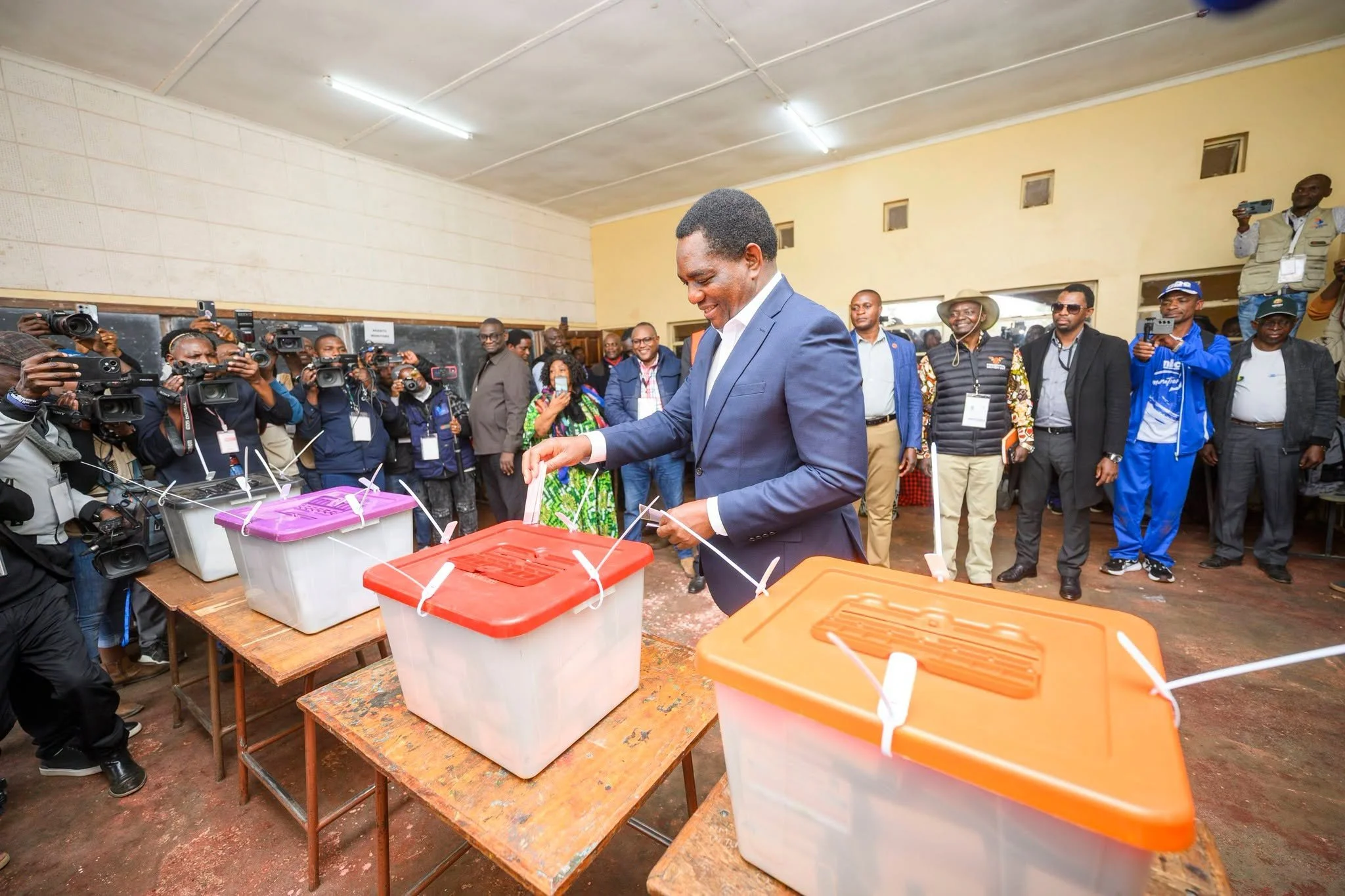
President Hakainde Hichilema casts his vote in the 2026 General Election
In this month's briefing:
Zambia re-elected President Hakainde Hichilema on 13 August and the market answered within days. The first bond auction since the vote, was oversubscribed by 37%, with bids exceeding the K6.3bn on offer, seven-year yields fell 101 basis points, and the Lusaka Securities Exchange set out plans for a record US$1bn of listings. Elsewhere in the economy, inflation fell to 6.2% and annual external debt service is set to drop to about US$900m from US$2.6bn. Copper output reached 447,182 tonnes in the first half of the year, Lumwana revenue rose 32% to US$852m. The Energy Regulation Board approved US$972m of investment, and Cabinet approved two new fuel pipelines. The Food Reserve Agency beat its maize target by more than 180,000 tonnes, and consultations opened on a new local content strategy.
🔢 AUGUST IN NUMBERS
→ 6.2% – August inflation, the lowest since February 2018
→ 14.79% – Seven-year bond yield at the first post-election auction, down 101 basis points
→ 40% – Rise in ZCCM-IH investment income for 2025
→ US$900m - Annual external debt service from 2026, down from US$2.6bn
→ US$1bn – Listings pipeline the Lusaka Securities Exchange expects to bring to market
→ 447,182t – Copper produced in the first half of 2026
→ US$852m – Lumwana revenue in the first half, up 32%
→ US$705m – Invested in Konkola Copper Mines since July 2024
→ US$972m – Energy sector investment approved by the Energy Regulation Board
→ 67MWp – Solar plant agreed for Chisamba by Solarcentury Africa and the IDC
→ 680,914t – Maize bought by the Food Reserve Agency, against a 500,000-tonne target
→ K3.4bn – Paid to farmers so far in the 2026 marketing season
→ 18.78 – Kwacha to the dollar after the result, Africa's best-performing currency this year
🗳 THE ELECTION AND THE ECONOMY
President Hichilema Declared Winner of August 13 Election
The Electoral Commission of Zambia declared President Hakainde Hichilema the winner of the general election in the early hours of 18 August. He received 2.97 million votes, or 60.5%, against 1.86 million and 38% for Brian Mundubile, on a turnout of 57.2%. The kwacha firmed 0.8% to 18.78 to the dollar on the day of the declaration. The Government has previously has said it will seek a new IMF programme by year-end.
Investors Welcome the Result as ContinuityThe outcome handed investors the policy continuity they had sought, with a new IMF programme identified as the first test of the second term. Zambia's 2033 dollar bond, its only international issue, was bid at 97.72 cents on the dollar on the day of the declaration, broadly unchanged against a weaker backdrop for African debt. The previous US$1.7bn arrangement expired in January. Stuart Culverhouse, Chief Economist and Head of Fixed Income Research at Tellimer, said: "For investors, Hichilema offers continuity." Philip Fielding, Portfolio Manager at Fidelity International, said a return to international markets "would give the companies in the country a benchmark to price debt off".
⚡MARKETS AND CAPITAL
ZZCM-IH Investment Income Rises 40% to K3.4bn
ZCCM Investments Holdings reported investment income up 40% to K3.4bn for the year ended 31 December 2025. Royalty income from Kansanshi reached US$64.5m, following commissioning of the S3 expansion, while dividend income doubled to K1.57bn, including first-ever dividends of US$39.2m from Maamba Energy and US$21.2m from Copperbelt Energy Corporation. The investment portfolio rose to US$1.91bn. Chief Executive Kakenenwa Muyangwa said ZCCM-IH and IRH have advanced approximately US$640m to Mopani's recapitalisation since the partnership began.
Inflation Cools To Eight-Year Low of 6.2%
Zambia's annual inflation fell to 6.2% in August, down from 6.5% in July and the lowest rate since February 2018, held near the floor of the Bank of Zambia's 6-8% target band by a strong kwacha that has contained import costs. Acting Statistician-General Chola Daka said prices rose 0.2% on the month, with food inflation easing to 6% and non-food to 6.6%. A moratorium on fuel taxes, extended last month to 30 September, has also eased pricing pressure. The Bank of Zambia cut its policy rate to 13.25% in May, a third consecutive reduction, with the next decision due at the end of September.
External Debt Service Falls to US$900m a Year
Zambia's annual external debt-service payments will fall to about US$900m from 2026, down from the estimated US$2.6bn a year the country would have owed without restructuring, according to Secretary to the Treasury Felix Nkulukusa. Debt service previously absorbed close to K70 of every K100 of domestic revenue collected and now takes about K15, freeing resources for education, health, agriculture, social protection and infrastructure. The fiscal deficit has narrowed from 9% in 2021 to 3.8% in 2025, and international reserves have risen from around US$3bn in 2021 to US$6.5bn by June 2026.
Bond Auction Draws Bids 37% Above Offer
The first bond auction since the election drew bids 37% above the K6.3bn on offer on 24 August, worth about US$332m, with the seven-year tightening 101 basis points to 14.79% and reversing a June sale that had failed to attract enough bids. Citigroup had gone overweight on Zambian debt days earlier, saying political continuity and the prospect of fiscal consolidation would likely give Moody's reason to upgrade Zambia from Caa2. Holders of Zambian local-currency debt have returned about 37% this year, second in the world only to Colombia. Eugene Hangoma, Head of Treasury Sales at First Capital Bank in Lusaka, called the result "an early, meaningful signal of post-election market confidence".
LuSE Expects Record US$1bn Listings PipelineThe Lusaka Securities Exchange expects to bring a record US$1bn of initial public offerings to market following the election, spanning manufacturing, telecommunications, mining, financial services and property. The main index more than doubled in dollar terms last year and remains near all-time highs, although first-half activity was slow, with the All-Share Index just below zero for the period and limited offshore participation. Chief Executive Nicholas Kabaso said the pipeline "will be unprecedented for us", and that strong copper prices remained "the biggest tailwind".
ZDA and LuSE Sign Capital Access AgreementThe Zambia Development Agency and the Lusaka Securities Exchange signed a memorandum of understanding on access to long-term capital, covering investment promotion, market access, green financing and trade promotion. The ZDA has registered close to 3,000 greenfield and brownfield companies between 2021 and 2026, many of which require financing, and Director General Albert Halwampa said lack of access to capital remains a major obstacle to projects reaching financial close. The partnership will use the Zambia Investment Deal Room platform to connect fund seekers with providers. Four LuSE-listed companies currently carry market capitalisations above US$1bn.
⛏ Mining and Copper
Copper Output Reaches 447,182 Tonnes in First Half of Year
Zambia produced 447,182 tonnes of copper in the first half of 2026, up 0.45% on the same period last year. Output rose at Kansanshi, Konkola, Lumwana and Lubambe, offset by declines at NFCA Mining, Chibuluma and Mopani, where planned maintenance at the Mindola shaft affected hoisting. Kansanshi is guided at 175,000 to 205,000 tonnes for 2026, rising to 230,000 to 260,000 tonnes by 2028, with Sentinel at 190,000 to 220,000 tonnes through the same period. Mining consumed about 63% of national electricity in 2025.
Lumwana Revenue Rises 32% to US$852mBarrick's Lumwana mine lifted first-half revenue 32.1% to US$852m, from US$645m a year earlier, as higher prices more than offset lower volumes. The average realised copper price rose to US$3.21 a pound, about US$7,077 a tonne, from US$2.51 a pound in the first half of 2025. Sales eased to 70,000 tonnes from 73,000 tonnes. Lumwana is expected to produce up to 150,000 tonnes this year. The Super Pit expansion targets first expanded output at the end of the first quarter of 2028, at around 240,000 tonnes a year over a mine life exceeding 30 years.
KCM Reports US$705m Invested Since 2024Konkola Copper Mines says it has invested more than US$705m in Zambia since Vedanta resumed stewardship in July 2024, covering development of the Konkola Deep Mining Project, mine infrastructure, tax contributions and community programmes. The company reports overall production more than doubled and integrated production tripled year on year, with underground development metres at KDMP up tenfold on pre-reinstatement levels. It plans around 44 kilometres of underground development this year and is targeting annual output of about 85,000 tonnes, with more than US$1bn earmarked for KDMP.
Government Opens Consultations on New Local Content Strategy
The Government has opened consultations on a new National Local Content Strategy, beginning in Southern Province, with the previous strategy having expired in 2022. The new framework is expected to promote locally produced goods and services, local materials, skills development, technology transfer and value addition. Livingstone District Commissioner Eunice Nawa said the objective is to build productive capacity that allows Zambian businesses to grow from small suppliers into competitive enterprises serving domestic and export markets. UNECA's Olayinka Bandele called for a capability-based approach going beyond procurement targets.
⚡ENERGY
Energy Regulation Board Approves US$972m of Investment
The Energy Regulation Board approved energy sector investments worth about US$972m, across electricity, renewables and petroleum. The approvals cover 23 licences and 20 construction permits, alongside licence expansions tied to development projects, and include two utility-scale solar developments, five new fuel retail stations and permits for 116 petroleum transport operators. Approved activities span renewable energy equipment manufacturing, petroleum transportation and distribution, and lubricant blending and import.
Solarcentury Africa and IDC Agree 67MWp Chisamba Plant
Solarcentury Africa and the Industrial Development Corporation have agreed heads of terms for a 67MWp solar plant near Chisamba in Central Province, designed primarily to supply large industrial users. The plant will connect to the ZESCO transmission backbone near Chisamba, reducing the need to move power from southern generation centres. The IDC has secured the site and completed initial technical studies, with Solarcentury Africa expected to lead development, design, financing and delivery.
Globeleq Commissions First Solar-Hydro Hybrid
Globeleq and Lunsemfwa Hydro Power Company have commissioned Zambia's first solar-hydro hybrid plant, integrating 27MWp of solar generation with LHPC's existing hydropower station. Globeleq, owned by British International Investment and Norfund, completed the acquisition of a 51% stake in the Kabwe-based company earlier this year; LHPC operates two hydroelectric plants totalling 56MW. Globeleq launched its Leopards Hill project in April, pairing 250MWp of solar with a 150MW battery storage system.
Cabinet Approves Tanzania and Namibia Fuel Pipelines
Cabinet approved two regional pipeline projects to diversify fuel supply routes, along with a shareholding structure for the first. The Tanzania-Zambia Multi-Products Pipeline will complement the existing TAZAMA line, carrying petrol, diesel, jet fuel and kerosene from Tanzania. The Namibia-Zambia Refined Petroleum and Natural Gas Pipeline establishes a western corridor carrying refined products and natural gas, opening the way for gas-to-power generation and industrial supply. Both are intended to reduce reliance on a single import corridor.
🏗 INFRASTRUCTURE AND INDUSTRY
ZAF and NAPSA Sign K150m Lusaka Water Pipeline
ZAF Projects and the National Pension Scheme Authority have signed a K150m contract for a bulk water supply pipeline, funded equally by the two parties and built by Lusaka Water Supply and Sanitation Company over 18 months. The 12-kilometre line runs from Stuard Park in Woodlands via Kingsland, ZAF Twin Palm Base and Datong to River View Park, and is expected to serve 25,000 residents.
Government Commissions Dams in Pemba and Kalomo
The Government has commissioned two dams in Southern Province, one in Pemba District and one in Kalomo District, to supply communities, livestock and agriculture in areas exposed to erratic rainfall. The facilities are intended to support productive activity year-round and give farmers water access through prolonged dry spells. Ministry of Water Development and Sanitation Permanent Secretary Mr Kamanga said the projects reflect cooperation between government, the private sector and other stakeholders under the Eighth National Development Plan, and handed over houses to families displaced by construction.
EU-Backed Project Targets Lobito Corridor Councils
The Commonwealth Local Government Forum has launched a project on inclusive local economic development along Zambia's stretch of the Lobito Corridor, supported by the European Union through Global Gateway. It covers councils in the Copperbelt and North-Western Provinces including Chingola, Kitwe, Ndola, Kalumbila, Solwezi and Kapiri Mposhi, where corridor investment in mining, agriculture and logistics will raise demand for land, housing, roads, water and sanitation. The work targets capacity building for newly elected councils and technical support for at least three priority councils during integrated development plan reviews.
🚜 AGRICULTURE
FRA Exceeds Maize Target With 680,914 Tonnes Brought
The Food Reserve Agency has bought 680,914 tonnes of Grade A white maize in the 2026 marketing season, exceeding its initial 500,000-tonne target, with more than K3.4bn disbursed to farmers so far. Maize is priced at K347 per 50kg bag and paddy rice at K300 per 40kg bag. Combined with carry-over stock of 1.455 million tonnes, national stocks now exceed two million tonnes. Board Chairperson Suresh Desai said a new digital payment system using mobile money and direct bank transfers has enabled prompt payment, and that the agency remains on the market.
Omnia Begins Construction of Lusaka Fertiliser Plant
Omnia has begun construction of a fertiliser blending plant in Lusaka in partnership with the Government, producing soil-specific blends matched to the nutrient requirements of different farming regions. The facility will receive, process, blend, package and distribute product. Country Manager Nigel Seabrook said the investment allows the company to produce customised blends based on soil nutrient requirements.
AUGUST MILESTONE ⛰️
President Hakainde Hichilema was re-elected on 18 August with 60.5% of the vote, and a mandate built on five years of economic stability and macroeconomic repair. Inflation, currently at 6.2%, has now sat inside the Bank of Zambia's 6-8% band for seven consecutive months after almost five years above it. The external position has turned with it, with a K30.1bn trade surplus in the year to July against a K4.1bn deficit over the same period last year. Markets answered within a week: the first bond auction since the vote, drew bids 37% above the K6.3bn on offer, the seven-year tightening 101 basis points, and holders of local-currency debt are up about 37% this year. The stability that drew close to US$10bn into mining now underwrites a second term, with the task of widening the share of those gains reaching ordinary Zambians.
👀 WHAT WE’RE WATCHING IN SEPTEMBER
→ The inauguration on 1 September and the opening weeks of the second term, with cabinet appointments and early policy signals the first indication of how the administration intends to convert stabilisation into growth.
→ The 24th Africa Down Under conference in Perth from 2 to 4 September, where ZCCM-IH will again showcase Zambia's mining and investment potential to Australian investors.
→ The Food Reserve Agency's buying campaign, which continues to the gazetted close of the marketing season on 31 October.
→ The Bank of Zambia's monetary policy decision at the end of September, following three consecutive cuts that took the benchmark rate to 13.25% in May.
QUOTE OF THE MONTH
“We can only redistribute the benefits of growth and that growth only comes through trade and investment.”
— President Hakainde Hichilema, in his national address following his election victory on 18 August 2026.